Athletes tend to be driven people. That includes the runner fitting a 10K plan around work, the cyclist who would happily ride every day, and anyone who wants to stay active without discomfort taking over.
But athletic performance depends on more than training. Sleep, recovery, strength, nutrition, stress and everyday responsibilities all affect what your body can reasonably support.
Drive can take you a long way. But drive is only one dial.
What Does a Stereo Have to Do with Athletic Training?
Think about an old stereo equalizer. You can adjust volume, bass, treble and balance. Turning every control to maximum doesn’t create better music. The bass overwhelms other sounds, the treble becomes harsh, and the details disappear.
The controls are there to be adjusted. One song may need different settings from another.
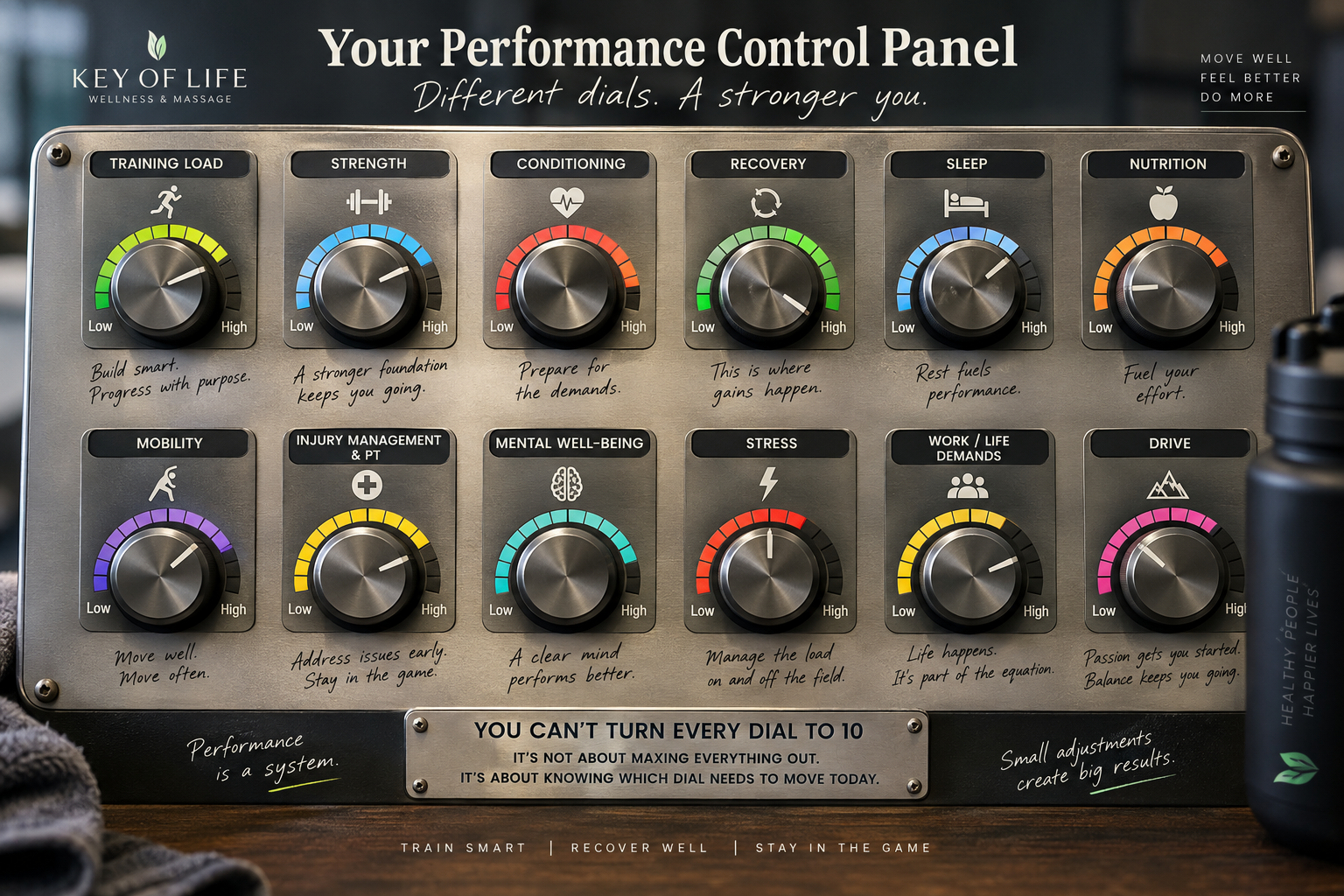
Your body isn’t a stereo, but the comparison is useful. Imagine a control panel for training load, strength, recovery, sleep, nutrition, injury management, stress and drive. None of those controls works entirely on its own.
The goal isn’t to turn every dial to 10. It’s to recognize which one needs to move.
When Training Goes Up, What Else Needs to Change?
Suppose you increase your weekly mileage for a 10K. You’ve turned up the training-load dial. Your body now has more work to accommodate and recover from.
But work is already demanding. There aren’t enough hours in the day, so sleep gets turned down. Recovery gets whatever time is left. Something starts hurting, but the race is approaching, so drive gets turned up again.
At that point, you may simply be asking more from the same support system.
Before adding another workout, consider:
Has your mileage, intensity or training frequency recently changed?
Are you getting enough sleep and time between demanding sessions?
Does your plan include strength and conditioning that support the activities you enjoy?
Are work, stress or family demands reducing your recovery time?
Is a recurring problem being evaluated, or are you repeatedly pushing through it?
These questions don’t diagnose an injury. They help you notice what deserves attention and what to discuss with your coach or healthcare professional.
Why More of the Same Isn’t Always the Answer
When you love running, physical therapy exercises can feel like time you should spend running. When you love cycling, strength training may be less appealing than another ride.
Sometimes changing things up helps you keep doing what you love. Strength, conditioning and rehabilitation can address demands that another run or ride won’t necessarily address.
A runner building distance may need a different plan from someone preparing for a triathlon or returning after an injury. As the goal changes, the support around it may need to change too. For a running-specific perspective, explore massage therapy for Charlotte runners.
Taking time for that supporting work can help you stay with the activities you enjoy.
Why Your Recovery Plan Has to Fit Your Real Life

It’s easy to compare your training with a professional athlete’s schedule. It’s harder to see the support surrounding that schedule: coaching, conditioning, rehabilitation, nutrition guidance, medical care and time dedicated to recovery.
Professional athletes can build their workday around training. You may be preparing for an event while teaching all day, sitting at a desk for 40 hours a week or raising children.
Those demands count. They don’t disappear when the workout begins.
A demanding week at work may call for a different training week. Rehabilitation may need to take priority for a while. Sometimes sleep needs to win. That isn’t automatically lost progress; it’s an adjustment.
Where Does Massage Fit into Training and Recovery?
Massage can be one part of an athlete’s support system. It isn’t the entire control panel.
For runners, cyclists and other active adults, a session can focus on muscular tension, comfort between activities and areas that repeatedly carry the demands of training. Research suggests massage may help with post-exercise soreness and flexibility, but it does not establish that massage directly improves strength, speed or endurance.
Massage cannot replace appropriate training, sleep or physical therapy. It should not be used to postpone evaluation of persistent or worsening pain, or a suspected injury.
At Key of Life Wellness & Massage, I want to understand what you’re asking your body to do:
What are you training for, and what has changed recently?
Where are you feeling the effects?
Does the same problem keep returning?
Are you working with a physical therapist or another healthcare professional?
Sometimes massage makes sense. Sometimes another kind of care needs to come first. The goal isn’t to make massage the answer to everything. It’s to understand where it fits.
Learn about sports massage for active adults in Charlotte or how massage and physical therapy can work together.
Balance Doesn’t Mean Giving Every Dial the Same Setting
A musician doesn’t ask every instrument to play at full volume. Balance comes from proportion and adjustment, not from making everything equal.
Your training may take priority during one season. Rehabilitation or a demanding stretch at work may change the settings during another. You adjust and continue.
The masterpiece isn’t having every dial turned to 10. It’s being able to do the thing you’re trying to do, with enough support to sustain it.
Explore Massage Support for Your Active Life in Charlotte
If you’re considering massage as part of your care, we can talk about your activity, concerns and goals before deciding how to approach your session.
Key of Life Wellness & Massage serves active adults in Charlotte, North Carolina.
Research reference: Effect of sports massage on performance and recovery: a systematic review and meta-analysis, BMJ Open Sport & Exercise Medicine (2020).